
The 1970s and 1980s were great years for music and television commercials. Growing up as a Gen Xer, there are many jingles I still know by heart all these years later.
But there was one commercial that stuck with me. Not because it was necessarily a great commercial, although the concept was brilliant. Rather, it created a sense of wonder in me as a child about the power of sound.
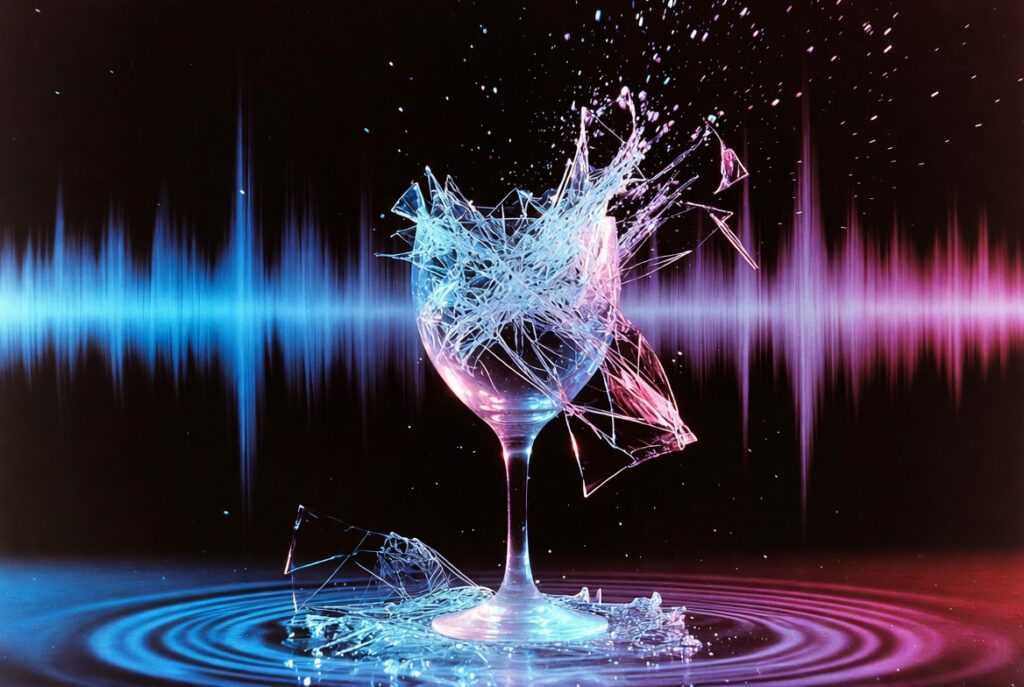
A cassette manufacturer called Memorex was running a commercial to prove the quality of their recording technology. The demonstration was simple and stunning. My all-time favorite jazz singer, Ella Fitzgerald, sang a live note and shattered a crystal glass. Then they played back the Memorex recording of that same note.
The glass shattered again.
The tagline said everything: “Is it live, or is it Memorex?”
I never forgot that moment. Not simply because it was a memorable commercial, but because something in me understood, even then, that sound is not merely decoration. Sound does something. I just did not know yet how deep that rabbit hole went.
Frequency Is Not Just Something You Hear
We are swimming in frequency every moment of our lives. The radio signal that carries music to your car. The Wi-Fi signal that connects you to the internet. The cell signal that carries a phone call across a thousand miles. These are all forms of electromagnetic frequency, invisible waves moving through the air around you right now, carrying information, energy, and sound.
The light you are reading this by is frequency. The warmth of the sun on your skin is frequency. Your brain, right now, is producing measurable electrical frequencies as you think. Your heart produces them. Your cells produce them.
Frequency is not a fringe concept. It is the language the physical universe runs on. Every object, every atom, every living thing vibrates. The question scientists have been exploring for decades is what happens when those vibrations interact with one another.
That cassette commercial answered one version of that question. When a sound wave finds the resonant frequency of an object, the energy transfers with remarkable efficiency. The vibrations amplify. And if the match is precise enough, something gives way.
That principle has shown up in some unexpected places throughout history. On April 12, 1831, a column of seventy-four British soldiers marched across the Broughton Suspension Bridge in Manchester in lockstep. Their synchronized footsteps matched the bridge’s natural resonant frequency. The vibrations amplified to the point that the bridge partially collapsed. Nobody died, but the lesson was not lost on military commanders. Soldiers have been ordered to break step when crossing bridges ever since.
Consider what happened at Jericho. Joshua 6 describes the entire Israelite fighting force, numbering over 600,000 men of fighting age according to the census in Numbers 26, marching around the city walls for seven days. On the seventh day they marched seven times, and at the sound of the trumpets the people gave a great shout. And the walls fell flat.
Scripture does not tell us precisely how God brought those walls down. Whether He used the natural laws of resonance He had built into creation, whether He dispatched heavenly forces, or whether He acted in a way entirely beyond our understanding, the text does not say. What it does say is that God chose sound as the instrument of obedience. Hundreds of thousands of voices and the blast of seven trumpets, unified and sustained, became the moment God acted.
Sound is not passive. Sound acts on the world around it.
What Scripture Knew First
Long before modern science began measuring the effects of frequency on the physical world, the Bible described a God who created everything through the power of spoken sound.
“In the beginning, God created the heavens and the earth… And God said, ‘Let there be light,’ and there was light.” (Genesis 1:1,3 NKJV)
He spoke. And existence happened.
The Gospel of John opens with one of the most remarkable statements in all of Scripture: “In the beginning was the Word, and the Word was with God, and the Word was God. He was in the beginning with God. All things were made through Him, and without Him nothing was made that was made.” (John 1:1-3 NKJV)
That Word is Jesus. Everything that exists, every vibrating atom, every measurable frequency, every wave of sound moving through the air right now, came into being through Him. He was not a bystander at Creation. He was central to it.
But it did not stop at Creation. The writer of Hebrews tells us that Jesus is even now “upholding all things by the word of His power.” (Hebrews 1:3 NKJV) Not past tense. Present tense. The same universe that scientists measure in frequencies and wavelengths is being actively sustained right now by the word of the Son of God.
The universe is not running on autopilot. It is being held together by a Person.
What Ella Fitzgerald Opened Up
I did not connect all of this immediately. It took decades of playing music, years of worshiping on stages and in prayer rooms, and eventually a deep dive into the intersection of sound and Scripture before the pieces started coming together.
But it started with that commercial. A crystal glass. A recorded voice. A frequency match. And a kid who thought, even then, that sound must matter more than anyone was telling him.
If God spoke the universe into existence, and if that universe still vibrates with measurable frequency, and if Jesus is sustaining all of it by the word of His power, then sound is not incidental to the Christian life.
It is central to it.
I have spent the past several years exploring exactly what that means for worship, for prayer, and for how we use sound in our everyday lives. One of the most significant things I discovered along the way is that the frequency at which we tune our instruments for worship may matter more than we ever realized. For the past several years I have been recording and worshiping at 444 Hz, a specific tuning that sits slightly above the modern standard. What I have experienced in those worship times, and what listeners have reported back to me, is what eventually compelled me to write it all down. That exploration became the foundation of my YouTube channel and eventually a book.
But it all started for me with a shattered glass and a jazz singer named Ella Fitzgerald.
Come explore it with me at https://youtube.com/skmurray
God bless you.
SK Murray